Sign in
12thPass logo
New chatPYQ LibraryDoubtsRank report
Sign in to see Recents

Your guest activity stays on this device

Sign in to save progress →
Sign in

Waves question

2017 · 8 Apr · Shift 1 · Q61
Guest · filters and generic practice availableBrowsing as a guest · PYQ filters and generic practice are available. Sign in only for personalised features and saved progress.
  1. PYQ Library
  2. /JEE Main
  3. /Physics
  4. /Waves
  5. /2017 · 8 Apr · Shift 1 · Q61

Waves question

2017 · 8 Apr · Shift 1 · Q61

JEE MainPhysicsWavesMCQ+4 / −1
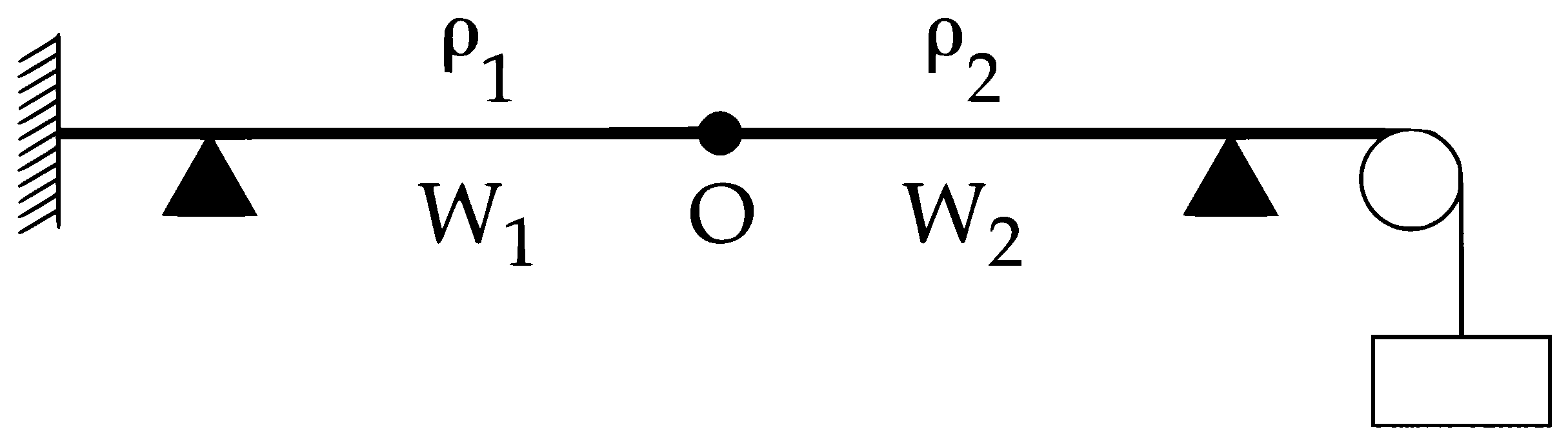
Two wires W1 and W2 have the same radius r and respective densities ρ\rhoρ 1 and ρ\rhoρ 2 such that ρ2 = 4 ρ\rhoρ 1 . They are joined together at the point O, as shown in the figure. The combination is used as a sonometer wire and kept under tension T. The point O is midway between the two bridges. When a stationary wave is set up in the composite wire, the joint is found to be a node. The ratio of the number of antinodes formed in W1 to W2 is : JEE Main 2017 (Online) 8th April Morning Slot Physics - Waves Question 113 English
  1. A
    1 : 1
  2. B
    1 : 2
  3. C
    1 : 3
  4. D
    4 : 1
View written solutionFree

Correct answer: B

  1. Given data
  • Two wires W1W_1W1​ and W2W_2W2​ have the same radius rrr.
  • Their material densities are ρ1\rho_1ρ1​ and ρ2\rho_2ρ2​ with ρ2=4ρ1.\rho_2 = 4\rho_1.ρ2​=4ρ1​.
  • They are joined at point OOO.
  • The point OOO is midway between the two bridges, so the vibrating lengths of the two parts are equal: L1=L2.L_1 = L_2.L1​=L2​.
  • The whole composite wire is under the same tension TTT.
  • In the stationary wave formed, the joint OOO is a node.

We need the ratio of the number of antinodes in W1W_1W1​ and W2W_2W2​.


  1. Linear mass densities of the two wires

Since both wires have the same radius, their cross-sectional area is the same: A=πr2.A = \pi r^2.A=πr2.

Hence linear mass density is μ=ρA.\mu = \rho A.μ=ρA.

So, μ1=ρ1A,μ2=ρ2A=4ρ1A=4μ1.\mu_1 = \rho_1 A, \qquad \mu_2 = \rho_2 A = 4\rho_1 A = 4\mu_1.μ1​=ρ1​A,μ2​=ρ2​A=4ρ1​A=4μ1​.

Thus, μ2=4μ1.\mu_2 = 4\mu_1.μ2​=4μ1​.


  1. Wave speeds in the two wires

Wave speed on a stretched string is v=Tμ.v = \sqrt{\frac{T}{\mu}}.v=μT​​.

Therefore, v1=Tμ1,  v2=Tμ2=T4μ1=v12.v_1 = \sqrt{\frac{T}{\mu_1}}, \,\, v_2 = \sqrt{\frac{T}{\mu_2}} = \sqrt{\frac{T}{4\mu_1}} = \frac{v_1}{2}.v1​=μ1​T​​,v2​=μ2​T​​=4μ1​T​​=2v1​​.

So, v1:v2=2:1.v_1 : v_2 = 2 : 1.v1​:v2​=2:1.


  1. Condition for stationary waves in each segment

Since the bridges are fixed ends and the joint OOO is also a node, each part behaves like a string fixed at both ends.

If n1n_1n1​ and n2n_2n2​ are the numbers of antinodes in W1W_1W1​ and W2W_2W2​ respectively, then for a string fixed at both ends: L=nλ2.L = n\frac{\lambda}{2}.L=n2λ​.

So, L1=n1λ12,L2=n2λ22.L_1 = n_1 \frac{\lambda_1}{2}, \qquad L_2 = n_2 \frac{\lambda_2}{2}.L1​=n1​2λ1​​,L2​=n2​2λ2​​.

Since L1=L2L_1 = L_2L1​=L2​, n1λ1=n2λ2.n_1 \lambda_1 = n_2 \lambda_2.n1​λ1​=n2​λ2​.


  1. Use same frequency in both segments

Because the two parts are joined and vibrate together, the frequency is the same: f=v1λ1=v2λ2.f = \frac{v_1}{\lambda_1} = \frac{v_2}{\lambda_2}.f=λ1​v1​​=λ2​v2​​.

Hence, λ1λ2=v1v2=2.\frac{\lambda_1}{\lambda_2} = \frac{v_1}{v_2} = 2.λ2​λ1​​=v2​v1​​=2.

So, λ1=2λ2.\lambda_1 = 2\lambda_2.λ1​=2λ2​.

Substitute into n1λ1=n2λ2:n_1 \lambda_1 = n_2 \lambda_2:n1​λ1​=n2​λ2​:

n1(2λ2)=n2λ2n_1(2\lambda_2) = n_2\lambda_2n1​(2λ2​)=n2​λ2​ 2n1=n22n_1 = n_22n1​=n2​ n1:n2=1:2.n_1 : n_2 = 1 : 2.n1​:n2​=1:2.


  1. Answer

The ratio of the number of antinodes formed in W1W_1W1​ to W2W_2W2​ is 1:2.\boxed{1:2}.1:2​.

So the correct option is B.

PreviousNext

More from Waves

  • In an experiment to determine the period of a simple pendulum of length 1 m, it is attached to different spherical bobs of radii r1 and r2 . The two spherical bobs have uniform mass distribution. If the relative difference in the periods,…2017 · MCQ
  • A standing wave is formed by the superposition of two waves travelling in opposite directions. The transverse displacement is given by y(x, t) = 0.5 sin (45π​x) cos(200 π t). What is the speed of the…2017 · MCQ
  • A pipe open at both ends has a fundamental frequency f in air. The pipe is dipped vertically in water so that half of it is in water. The fundamental frequency of the air column is now :2016 · MCQ
  • A uniform string of length 20m is suspended from a rigid support. A short wave pulse is introduced at its lowest end. It starts moving up the string. The time taken to reach the supports is : (take g=10ms−2 )2016 · MCQ
  • A pipe of length 85cm is closed from one end. Find the number of possible natural oscillations of air column in the pipe whose frequencies lie below 1250Hz. The velocity of sound in air is 340m/s.2014 · MCQ
  • A sonometer wire of length 1.5m is made of steel. The tension in it produces an elastic strain of 1%. What is the fundamental frequency of steel if density and elasticity of steel are 7.7×10³kg/m3 and 2.2×10¹¹N/m2…2013 · MCQ
  • A cylindrical tube, open at both ends, has a fundamental frequency, f, in air. The tube is dipped vertically in water so that half of it is in water. The fundamental frequency of the air-column is now :2012 · MCQ
  • The transverse displacement y(x,t) of a wave on a string is given by y(x,t)=e−(ax2+bt2+2ab​xt). This represents a:2011 · MCQ