JEE MainPhysicsCenter of MassMCQ+4 / −1
As shown in figure, when a spherical cavity (centered at O) of radius 1 is cut out of a uniform sphere of radius R (centered at C), the centre of mass of remaining (shaded) part of sphere is at G, i.e, on the surface of the cavity. R can be detemined by the equation : 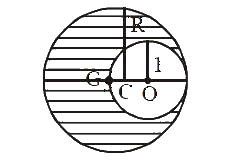
- A(R2 + R – 1) (2 – R) = 1
- B(R2 – R – 1) (2 – R) = 1
- C(R2 – R + 1) (2 – R) = 1
- D(R2 + R + 1) (2 – R) = 1
View written solutionFree
Correct answer: D
- Set up the geometry
Let the big sphere have:
- radius
- center
A smaller spherical cavity of radius is removed, with center .
From the figure/context, the cavity is internally tangent to the outer sphere, so the distance between centers is
The center of mass of the remaining body lies on the line and is given to be on the surface of the cavity.
Since the cavity surface is at distance from , and from the usual figure lies on the far side of from , we have Hence So the COM of the remaining part is at distance from .
- Use negative mass method
Treat the removed cavity as a sphere of negative mass.
Let density be .
Then
- mass of full sphere:
- mass of removed cavity:
So effectively, a mass is removed from point , whose distance from is .
Take as origin and positive direction toward . Then COM of remaining body is
= -\frac{m(R-1)}{M-m}.$$ Thus its distance from $C$ is $$CG = \frac{m(R-1)}{M-m}.$$ Substitute $M = mR^3$: $$CG = \frac{m(R-1)}{m(R^3-1)} = \frac{R-1}{R^3-1}.$$ But this is only the dimensionless fraction if cavity radius were scaled out incorrectly. Let us write it carefully including actual masses: Since $$M = kR^3,\qquad m=k$$ with $k=\frac{4}{3}\pi\rho$, we get $$CG = \frac{k(R-1)}{k(R^3-1)} = \frac{R-1}{R^3-1}.$$ This simplifies to $$CG = \frac{1}{R^2+R+1}.$$ This is the shift from $C$ toward the side opposite the cavity, so the point $G$ lies on the side away from $O$. Hence distance from $O$ to $G$ is $$OG = CO + CG = (R-1) + \frac{1}{R^2+R+1}.$$ Given that $G$ is on the cavity surface, $$OG = 1.$$ Therefore, $$(R-1) + \frac{1}{R^2+R+1} = 1.$$ So $$\frac{1}{R^2+R+1} = 2-R.$$ Rearranging, $$(R^2+R+1)(2-R)=1.$$ --- 3. **Match with options** This is exactly: $$\boxed{(R^2+R+1)(2-R)=1}$$ So the correct option is **D**. --- 4. **Comparison with stored answer** Stored correct answer: **D** Our derived answer: **D** They agree.More from Center of Mass
- Two particles of equal mass m have respective initial velocities and . They collide completely inelastically. The energy lost in the process is :2020 · MCQ
- A particle of mass m is projected with a speed u from the ground at an angle w.r.t. horizontal (x-axis). When it has reached its maximum height, it collides completely inelastically with another particle of the…2020 · MCQ
- A rod of length L has non-uniform linear mass density given by (x) = , where a and b are constants and 0 x L. The value of x for the centre of mass of the rod is at :2020 · MCQ
- If 1022 gas molecules each of mass 10–26 kg collide with a surface (perpendicular to it) elastically per second over an area 1 m2 with a speed 104 m/s, the pressure exerted by the gas molecules will be of the order of :2019 · MCQ
- Four particles A, B, C and D with masses mA = m, mB = 2m, mC = 3m and mD = 4m are at the corners of a square. They have accelerations of equal magnitude with directions as shown. The acceleration of the centre of mass of the particles is : Includes diagram2019 · MCQ
- A body of mass m1 moving with an unknown velocity of , undergoes a collinear collision with a body of mass m2 moving with a velocity . After collision, m1 and m2 move with…2019 · MCQ
- A uniform rectangular thin sheet ABCD of mass M has length a and breadth b, as shown in the figure. If the shaded portion HBGO is cut-off, the coordinates of the centre of mass of the remaining portion will be :- Includes diagram2019 · MCQ
- A ball is thrown vertically up (taken as +z-axis) from the ground. The correct momentum-height (p-h) diagram is :2019 · MCQ